
Contents
- AI search does more than rank pages. It builds answers.
- What AI search systems use to build an answer
- The entity clarity problem most brands overlook
- Content strategies that improve AI visibility
- Local AI visibility is a different challenge
- Technical foundations that support AI visibility
- Third-party authority and digital PR
- How to measure AI search visibility
- Common AI visibility mistakes
- Frequently asked questions about brand visibility in AI search
- How to improve brand visibility in AI search engines
A few weeks ago, we tested how Miley Studios appeared in an AI-generated search result for agencies in our market.
We were present, but only as a citation. Other agencies were named and described directly, with a sentence explaining who they were and what they did.
It exposed a meaningful distinction: being available to an AI search system is not the same as being understood by it.

That result prompted us to examine how Miley Studios was represented across our website, business profiles, directories, third-party mentions, and structured data. We found places where our positioning was clear to a person but harder for a search system to summarize confidently.
So, what strategies improve brand visibility in AI search engines? Make your brand easy to identify, verify, and cite. Publish useful content that answers specific questions. Keep core business information accurate across the web. Earn credible third-party mentions. Maintain the technical foundations that let search systems crawl and understand your content.
This article shares what established search guidance supports, what we observed in our own visibility review, and what brands should do next.
AI search does more than rank pages. It builds answers.
Traditional search typically presents a ranked set of pages. AI search adds another layer: it retrieves information from multiple sources, evaluates what is relevant, and synthesizes an answer. In some responses, a brand may be named and described directly. In others, its website may appear only as a supporting citation.
That distinction is useful, but it is not a literal either-or rule. AI systems still retrieve and rank sources. The opportunity is to improve both your pages and the broader set of signals that help a system understand who you are.
Google says the same foundational SEO practices used for Search also apply to AI Overviews and AI Mode. Pages still need to be crawlable, indexed, useful, and eligible to appear in search. AI visibility expands that work. It does not replace it.
Google’s guidance for AI features and websites reinforces a practical point: strong AI visibility begins with strong search fundamentals.
What AI search systems use to build an answer
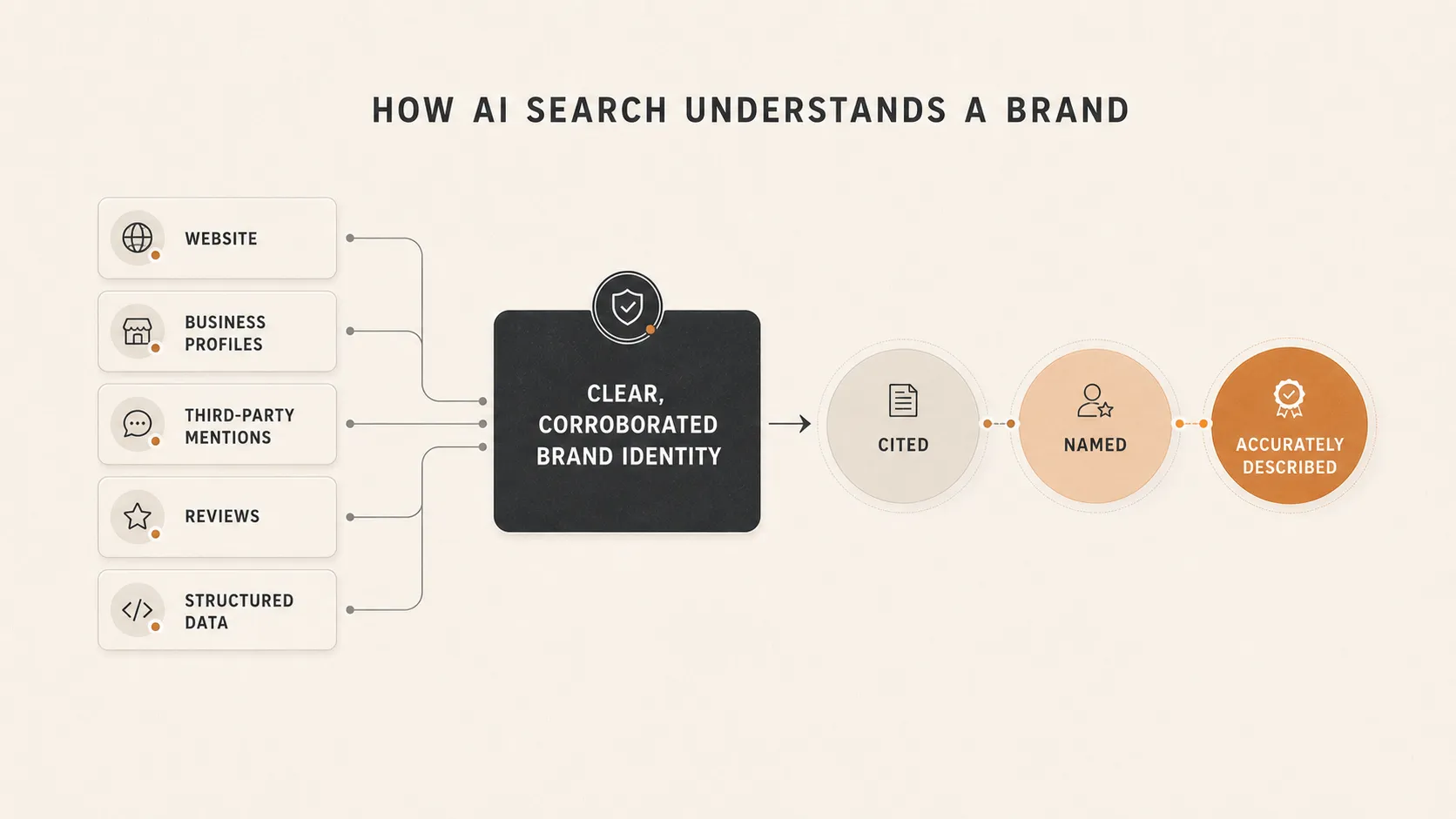
AI platforms do not disclose a universal list of sources or a fixed formula for selecting brands. Different systems also produce different answers. Still, several source categories consistently deserve attention:
- Your website. Clear service pages, useful articles, descriptive headings, internal links, and accurate organizational information help search systems understand your expertise.
- Business profiles. For local discovery, complete and current information in Google Business Profile and other relevant profiles improves clarity and eligibility.
- Independent sources. Journalism, industry publications, association pages, partner websites, and credible case studies can provide third-party confirmation of your work and reputation.
- Relevant directories and review platforms. These may be useful when buyers and search systems rely on them for your category. Their value depends on relevance and credibility, not the number of listings you can accumulate.
- Structured information. Schema markup can help search engines interpret organizations, articles, services, and other page content when it accurately reflects what visitors can see.
The goal is not to appear everywhere. It is to present a coherent, verifiable brand wherever your buyers and the systems serving them are likely to look.
The entity clarity problem most brands overlook
Many brand websites are written almost entirely in first person: “We help organizations clarify their positioning” or “We build digital experiences that move businesses forward.” That language may work well for people, but it does not always provide a concise description that another source can reuse.
A canonical entity description solves part of that problem. It should state your name, location when relevant, category, primary capabilities, and the clients you serve. For example:
Miley Studios is a Reno-based creative and digital marketing agency that helps growth-minded organizations strengthen their brands, build performance-focused websites, and execute integrated marketing.
Use the same core facts across your website, Google Business Profile, LinkedIn, relevant directories, and partner profiles. The wording can adapt to each platform. What matters is that the underlying identity remains consistent.
This is a positioning discipline as much as a search tactic. If your company cannot be described clearly in one sentence, AI systems are not the only audience likely to misunderstand it.
Content strategies that improve AI visibility
The strongest content strategies do not produce robotic copy for machines. They make genuine expertise easier to retrieve, understand, and trust.
- Answer specific questions early. Give readers a useful answer near the top, then provide the context, evidence, and nuance that support it.
- Build topical depth. Develop connected resources around the problems your organization is qualified to solve. A coherent body of work is more valuable than disconnected posts created only to target keywords.
- Contribute original evidence. First-party research, project results, expert observations, and clearly explained frameworks give other sources a reason to cite you.
- Support important claims. Link to primary sources, distinguish evidence from opinion, and avoid turning a limited observation into a universal rule.
- Make expertise easy to navigate. Connect articles to a relevant brand strategy service page, case studies, author information, and related insights so the subject relationship is clear.
Useful content remains the center of the strategy. Formatting can improve extraction, but it cannot manufacture authority.
Local AI visibility is a different challenge
Local visibility adds geographic relevance to the equation. Google states that local results are primarily shaped by relevance, distance, and prominence. Complete business information, links, reviews, and overall recognition can all contribute to how a company appears in local search.
For a location-based brand, prioritize:
- A complete and accurate Google Business Profile with the right categories, services, hours, contact information, photos, and review responses.
- Consistent core business facts across the website and reputable local or industry profiles.
- Reviews that reflect real client experiences. Never script or keyword-stuff them.
- Relevant local coverage, association memberships, partnerships, awards, and community involvement that can be independently verified.
- Location pages that provide meaningful information rather than thin, duplicated city copy.
Google’s local ranking guidance is a better foundation than any claim that one directory or tactic controls AI visibility.
Technical foundations that support AI visibility
The technical layer matters because content cannot be selected if it cannot be found, indexed, or interpreted correctly.
- Allow appropriate crawl access. Check robots.txt, indexing directives, CDN rules, and security settings. OpenAI specifically advises publishers not to block OAI-SearchBot if they want content included in ChatGPT search summaries and citations.
- Maintain an accurate XML sitemap. This helps search engines discover important and recently updated pages.
- Keep important information in visible text. Do not place essential facts only inside images, video, or interactive elements that are difficult to interpret.
- Use descriptive internal links. Help people and crawlers understand how articles, services, locations, case studies, and expertise relate.
- Implement accurate structured data. Organization, LocalBusiness, and Article markup can clarify page meaning when the markup matches the visible content. There is no special AI schema that guarantees inclusion.
- Provide a strong page experience. Mobile usability, accessibility, speed, and clear information architecture remain worthwhile search and conversion fundamentals.
For ChatGPT specifically, review OpenAI’s guidance for publishers and developers. For Google, continue to use Search Console to verify indexing and diagnose technical issues.
Third-party authority and digital PR
A brand’s own website can explain its value, but independent sources can confirm it. That makes earned visibility strategically important.
Useful third-party signals may include expert commentary in an industry publication, substantive local business coverage, a partner case study, an association profile, conference participation, or a credible award. The quality and relevance of the source matter more than raw mention volume.
Social media can extend the reach of this work and create more opportunities for people to discover or reference it. It should not be treated as a guaranteed AI ranking factor.
The strongest digital PR strategy is not “get mentioned for AI.” It is to contribute ideas, evidence, and expertise that respected sources genuinely want to publish. That improves reputation with buyers regardless of how any single AI platform changes.
How to measure AI search visibility
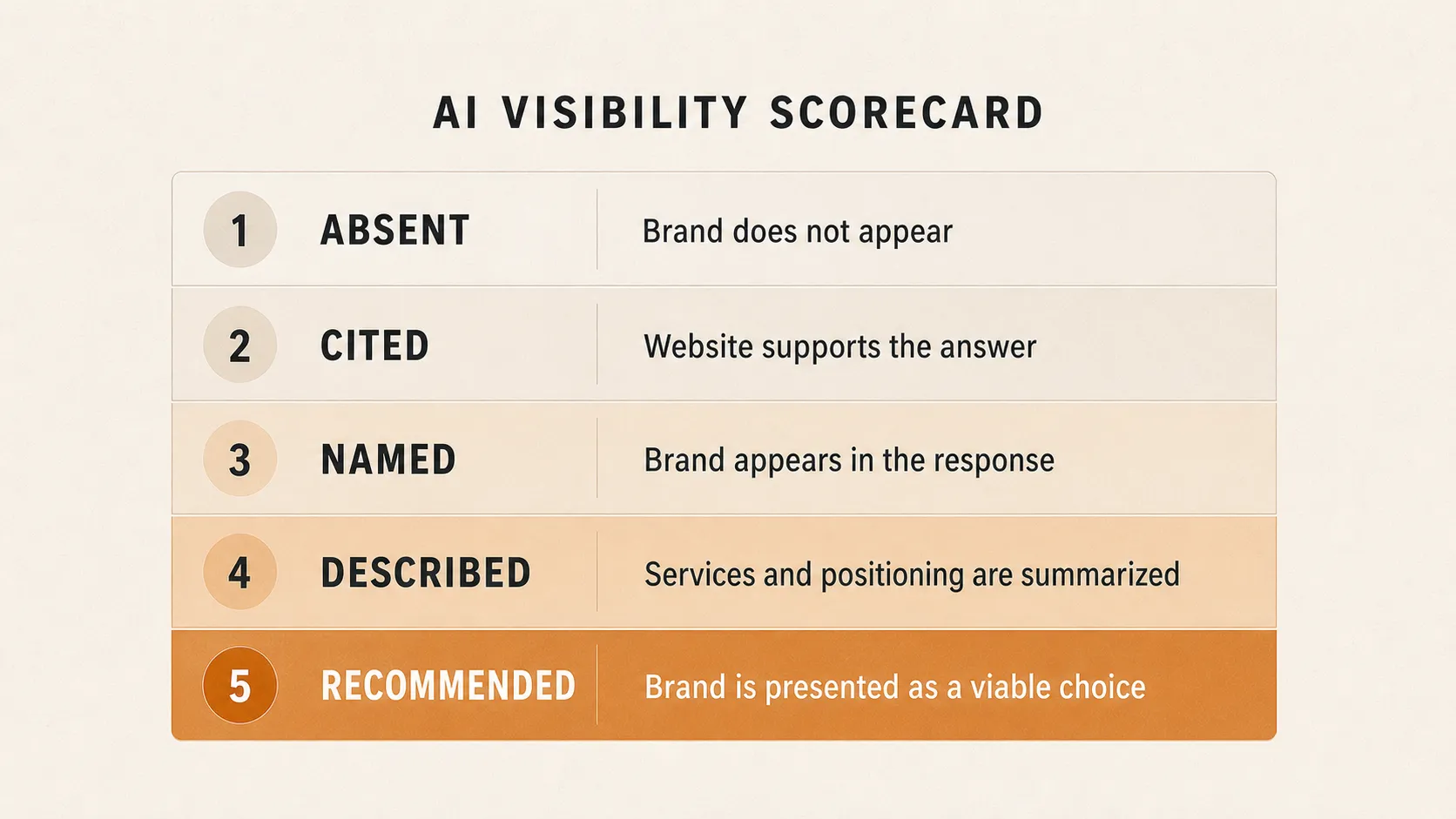
AI answers vary by platform, wording, location, timing, and repeated run. One incognito search is a useful signal, but it is not a measurement system.
Create a repeatable benchmark instead:
- Define a fixed prompt set. Include category, location, comparison, problem-aware, and recommendation queries that reflect how buyers actually research.
- Run prompts more than once. Test fresh sessions across the platforms that matter to your audience, and record the date and general location.
- Track the role your brand plays. Note whether you are absent, cited, named, recommended, or described inaccurately.
- Record cited sources. Look for patterns in which pages and third-party sources support the answers.
- Measure business outcomes. Track referral traffic where available, assisted conversions, branded search, qualified inquiries, and changes in how prospects describe finding you.
Search Console includes Google AI-feature activity within its broader Web reporting. OpenAI allows publishers to identify ChatGPT referral traffic in analytics. AI visibility tools can add useful directional data, but none should be treated as a complete view of every generated answer.
Common AI visibility mistakes
Separating AI visibility from SEO. AI answers still depend heavily on searchable, accessible, useful information. Treat AI visibility as an extension of search, reputation, and brand strategy.
Publishing generic content at scale. Repeating information already available everywhere gives an AI system little reason to cite your version. Original experience and evidence create more value.
Presenting assumptions as facts. AI platforms reveal only part of how their systems work. Clear attribution protects credibility and helps readers distinguish official guidance from field observations.
Chasing every directory. Low-quality listings create maintenance work and may weaken brand perception. Prioritize credible platforms used by your actual market.
Forcing identical language everywhere. Keep core facts consistent, but adapt the expression to fit each platform and audience.
Tracking mentions without accuracy. Being named is not enough. The description should reflect the services, positioning, geography, and expertise you want associated with the brand.
Frequently asked questions about brand visibility in AI search
What is the difference between traditional SEO and AI search visibility?
Traditional SEO focuses on making pages discoverable and competitive in search results. AI search visibility also considers whether a brand or its content is selected, cited, summarized, and described accurately inside a generated answer. The disciplines overlap substantially.
How long does it take to improve AI visibility?
There is no reliable universal timeline. Technical changes may be discovered after a recrawl, while stronger authority and third-party recognition can take much longer. Measure progress through repeated benchmarks rather than promising a fixed number of weeks or months.
Does schema markup help with AI visibility?
Structured data can help search engines understand an organization and its content, but it is not a shortcut or guarantee. Google states that no special schema is required for its AI features. Markup should be accurate and consistent with the visible page.
Which AI search platforms matter most?
That depends on your audience and market. Google’s AI experiences matter for discovery inside Search. ChatGPT, Perplexity, Gemini, and Microsoft Copilot may matter during research and comparison. Use audience behavior and referral data to decide where to focus.
Can a smaller brand compete with a larger organization?
Yes, especially when the smaller brand has sharper expertise, stronger local relevance, clearer information, or more useful evidence. Size alone does not guarantee that a system can understand or confidently cite a brand.
How to improve brand visibility in AI search engines
Our own search result revealed a gap worth addressing. We were visible as a source, but our brand was not being described with the clarity we expected.
The response is not to chase a new collection of AI tricks. It is to strengthen an integrated visibility strategy: precise positioning, useful content, credible third-party validation, accurate business information, and sound technical SEO.
AI search is evolving quickly, and no agency can credibly promise control over generated answers. What organizations can control is how clearly and consistently their expertise is represented across the sources those systems can access.
At Miley Studios, we help organizations make brand, content, and digital presence work together as a system. If your brand is difficult to find, inconsistently described, or missing from important AI-assisted research, explore our SEO and AI search strategy services or let’s talk.